|
What are legal rights?
And who has them?
In answering these questions, we tend to make the mistake
of thinking of the present as being characteristic of what always was and always
will be. But consider the evolution of the concepts of the "Rights of Man".
THE RIGHTS OF MAN CONCEPT
Our belief in the American way of life and the
concepts on which our society or government is based should not obscure the fact
that at one time there was no American way of life and that the concept of man
possessing rights recognized by government was the fruit of more than a
revolution---it was a product of creation. While many religious leaders,
philosophers, and poets spoke of the rights of man and the dignity of man,
governments laughed at such pretensions and held man tightly in a society based
on status. If he were a nobleman, he had the rights of a nobleman of his degree.
If he were a warrior, he had the rights of a warrior. If a slave, he had very
few rights at all. In each case, the law only saw status; it was not the man who
had rights but the status of the nobleman, the status of the warrior, the status
of the slave.
In the course of time, serfdom displaced slavery in much of the Western world.
Eventually feudalism disappeared and, with the end of the Thirty Years War, the
modern society of nations began to emerge. Surely one might say that in such a
"new order" man had legal rights. No, not as a man but as a subject. Even when
the English colonists settled in America, they brought with them not the rights
of men but the rights of British subjects. Even when the colonies were within
one year of war, their Second Continental Congress presented to King George III
the Olive Branch Petition in which they beseeched him to recognize their rights
as Englishmen. For almost a year the destiny of the colonies hung in the balance
as to whether they should stay within the empire, seeking to obtain recognition
of their rights as Englishmen, a "status" recognition, or whether they should do
something more.
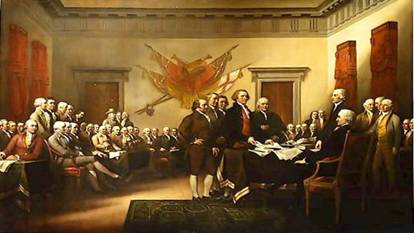
Finally, the ill-advised policies of George III and the eloquence of Thomas
Paine's Common Sense tipped the scales and the colonies spoke on July 4, 1776,
not in the terms of the rights of English subjects, but in terms of the rights of
man existing independently of any government. Had the American Revolution been
lost, the Declaration of Independence would have gone rattling down the
corridors of time with many other failures. But the American Revolution was won,
and the new government that was established was based upon "man" as the building
block rather than upon "subjects." Rights of man replaced the concept of rights
of subjects. With this transition, the obligations of a king to his faithful
subjects were replaced by the rights of man existing without regard to the will
or authority of any king. Since then, America has gone through additional
stages of determining what is embraced by the concept of "rights of man",
and many changes have occurred along the way. And though there have been
times we have struggled to find the right way, it remains a challenge that
America will forever be up to facing head on.
|